


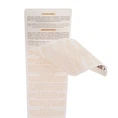

I. Clarify Regulatory Bottom Lines: Which Information Must Be "Visible"?
According to Article 5 of the Regulations on the Administration of Cosmetic Labels and the General Rules for Labeling of Prepackaged Foods (GB 7718-2025), the label of the smallest sales unit must ensure that consumers can access all mandatory labeling information without damaging the packaging. This means that the following information must not be placed in an inner layer that requires tearing, scraping, or unfolding to see:
Product Name (Chinese)
Net Content
Production Date and Shelf Life (or Expiry Date)
Registrant, Filer, and Manufacturer's Name and Address
Special Cosmetic Registration Certificate Number
Full Ingredient List (Cosmetic)
Safety Warnings (e.g., "Keep Out of Children," "Avoid Direct Sunlight")
If a folded or multi-layered structure is used, but the above information is not visible due to being wrapped in plastic film, it is considered a violation.
II. Utilize the "Visible Surface" Principle and Rationally Allocate Information Hierarchy
Article 22 of the Regulations on the Administration of Cosmetic Labels defines "visible surface" as any surface that consumers can directly see without damaging the sales packaging. Therefore, compliant design should follow these principles:
Surface Layer (Exposed Layer): Displays all legally required labeling information prominently, ensuring clarity at a glance.
Middle Layer (Releasable Layer): Used for supplementary content, such as usage instructions, multilingual instructions, and nutritional information (non-mandatory items).
Bottom Layer (Hidden Layer): Used only for information that does not involve consumers' right to know, such as anti-counterfeiting verification codes, serial numbers, and internal traceability codes.
Example: An exported cosmetic product could have its Chinese and English names, net content, and production batch number labeled on the outer layer; after peeling off the outer layer, it could display French/German instructions, detailed ingredient explanations, and a QR code linking to an electronic instruction manual.
III. Special Treatment for Small-Sized Packaging For small-sized packaging (e.g., samples, trial packs) with a net content ≤15g or 15mL, regulations allow for simplified labeling:
Only the following information can be labeled on the visible side of the sales packaging: Product Chinese Name, Registration Certificate Number, Filing Person's Name, Net Content, and Expiry Date; Other information (e.g., ingredients, usage instructions) can be included in the accompanying instructions.
Multi-layered labeling is highly advantageous in this scenario, allowing the instructions to be integrated into the inner layer, achieving both compliance and space saving.
IV. Caution Required in Managing Innovative Terminology and Claims If innovative terms not yet widely understood in the industry (e.g., "microecological balance factor") are used on the label, an explanation must be provided in an adjacent location to avoid misleading consumers. Simultaneously, the following behaviors are strictly prohibited:
Using medical terminology to imply therapeutic effects (e.g., "acne removal" or "repair"); Making false claims using font size, color contrast, or homophones; Fabricating scientific research results or citing unverified data.
V. Digital Labels as a Supplement, Not a Replacement for Physical Labels
According to the new clause in the General Rules for Labeling of Prepackaged Foods (GB 7718-2025), more information (such as production process, origin traceability, and consumption recommendations) may be displayed through digital labels such as QR codes. However:
Digital labels cannot replace the mandatory labeling content on physical labels;
The content scanned must be consistent with the registration and filing information and must not be tampered with;
Placing QR codes in the middle or bottom layer is encouraged as an entry point for anti-counterfeiting and interaction.
